What is ITLine AI+? AI+ modules for Claude, by monthly subscription.
Custom software and AI agent development for small and mid-sized companies
Less typing, more time for your clients. ITLine AI+, from 26 Oct.
Ready-made AI tools for Claude for office work. Software engineers build and test them; by subscription you always work with the newest version.
- Neither boxed nor cobbled together: tested engineering.
- Client data stays in the company; the AI sees code names.
- We also build custom systems, consult and train.
What is the problem?
Client data cannot go to the AI
Names and identifiers become code names inside the company before the text goes to Claude.
AI privacy gateway
Three weeks later nobody remembers the decision
Live Hungarian transcript, and a warning when something clashes with an earlier decision.
Copilot Wall
The website is stale and AI search ignores us
Your team keeps it fresh with its own AI assistant; people and AI search read it precisely.
ITLine Studio
Orders arrive by e-mail, and someone types them in by hand
Order intake, proforma invoices, invoicing, stock and a reseller portal: in one system, on one database.
Business management and trade
I don't need an ERP. I just want the chaos to stop
One interface: who is coming when, what came of it, what has been invoiced and what is left. No more.
Back-office order for a small firm
Our old system works, but nobody fully understands it
We map what it does from the source code and the running system, with code references. Fixes come after.
Legacy reverse engineering, refactoring
Who for?
Trading companies
Orders arrive by e-mail, PDF or phone; someone types them in by hand.
Manufacturers’ office teams
Hundreds of e-mails a day, and you do not want to hire six more people.
Webshops
There is never time for product descriptions, posts and the newsletter.
Small firms and sole traders
Few people, many roles: calendar, invoices and requests live in three places.
Accounting offices
Client tax IDs cannot go into ChatGPT, yet half the work is text.
...or just scroll ↓
How we work
We lead AI agents, not write lines of code.
Understand
We analyze the business problem. Existing system? We map it with AI.
Specify
We create precise, machine-readable specifications. Senior experience tells us WHAT to build.
Today, implementation is no longer what takes the longest. Defining what to build is.
AI agents implement
Our custom orchestration system drives the agents. Cognitive memory, custom tools, spec-driven workflow.
A site manager doesn't lay bricks. They design the building, coordinate the work and ensure quality. We do the same in software, except our workers are AI agents.
Review + Testing
All code is automatically tested. Our seniors validate the OUTCOME, not individual lines.
Done
Days to weeks, not months.
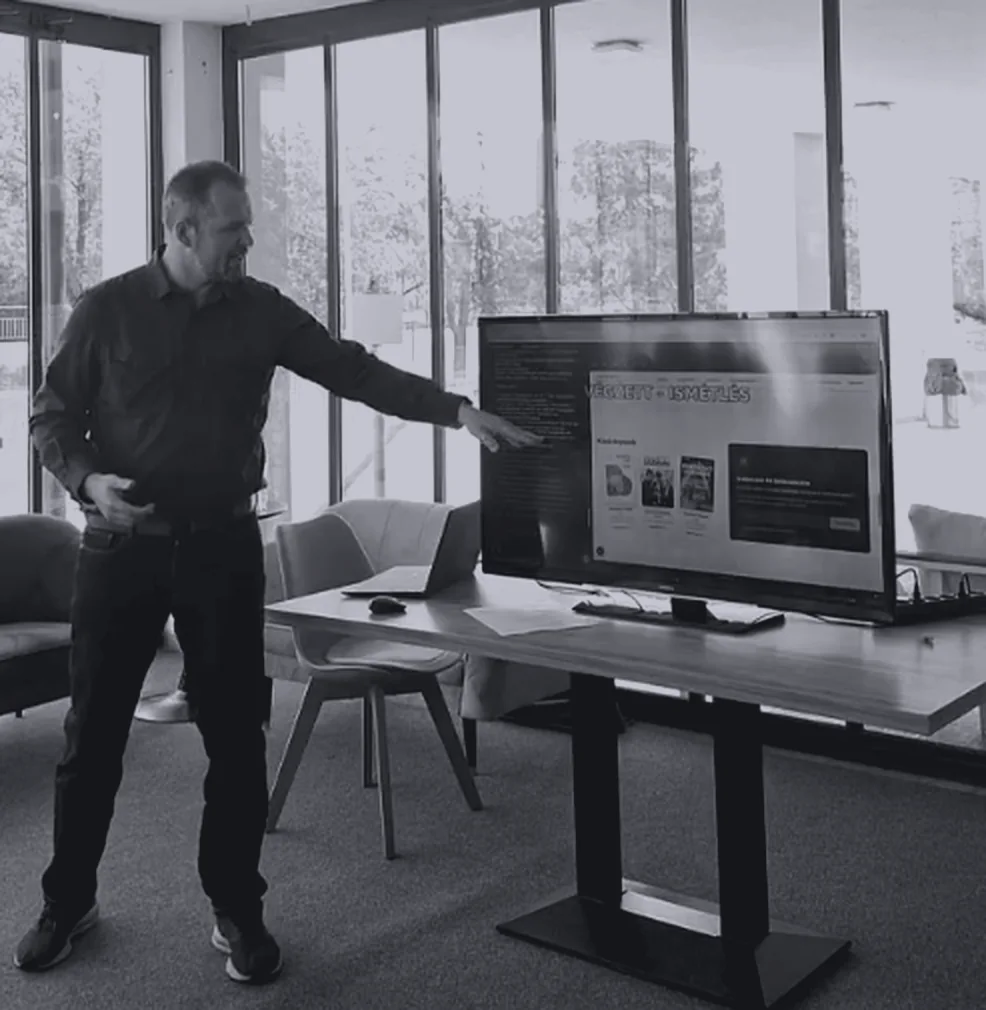
Software development is fundamentally changing. We build on that.
By the numbers
What we can measure, we publish. What we cannot, we stay quiet about.
28+
years of software development experience, the founder's
10 000+
products in the catalogue of a live system we built
1
week to stand up a complete business system
About us
ITLine Kft. was founded in 2004. Both founders are developers, not managers: the 28+ years of software development experience belong to one person, not to a team's years added together.
The other founder created and leads pi-agent-dashboard (an MIT-licensed, open source control surface for coding-agent sessions) and heads the AI team at a Hungarian software company. So we do not look at the agentic layer from the outside: we work inside it, every day.
We do not buy our AI direction, we build it: our own open source orchestration framework, published as SET, drives the work. Partners run it in production; built in Hungary, with an international professional background.
40-minute executive overview of SET, live demos, the latest materials: Resources →
We also work on R&D projects.
The ITLine timeline
- 2004
The company is founded
In the Infopark years, when founding a software company still made sense because writing software was expensive. The first own product was a point-of-sale system for retail. Most of the work, though, was enterprise: banks, telecoms, large public-administration systems, international projects.
- The 2010s
Abroad
The company lies dormant; the career does not. The work continues independently. This stretch answers what the public filing shows: the company did not shrink, it stood still.
- 2024
Development restarts
A two-year R&D project starts, in consortium. The return was not nostalgia: there has been no shift this big in computing since the internet arrived.
- 2026
An AI-native ERP in production
A mid-sized trading company's entire operation: order intake, billing, stock, reseller portal. Site and logistics modules have been building on it since.
- 2026
The team grows
New colleagues, strategic partnerships and the AI direction reinforced. The weekly professional newsletter has run without a gap this year.
Contact
ITLine Kft.
Tax ID: 13168085-2-06
Where we work
ITLine moves mostly along the Budapest–Szeged axis: most meetings happen in these two cities, and we can meet in person in either one, by prior arrangement.
The bulk of the work runs remotely, because the survey, the specification and the development are fastest that way. What needs someone in the room happens in the room: the opening survey conversation, the handover and the training.
We take on work from anywhere in Hungary. So far we have given chamber-of-commerce talks in Szolnok and in Szeged.
Service area: Budapest · Szeged · Debrecen · Kecskemét · Szolnok · Győr · Pécs · Miskolc